Tuesday, December 05, 2006

REVIEW: "The Space Sentinels": Filmation's Mythological Trio Return on DVD

[Article written for Toon Zone News - 27.10.06]

Nostalgia trips are a double-edged sword. Putting it slightly more pretentiously, one can only look to the past, with the eyes of the present. Adding even more ostentatiously to that, we can never recapture that magic of our youth -- merely skim the surface of our memories.

To add the icing to this rather pompous-looking cake, I will further suggest that the best we can hope for in any reminiscence is a shallow reflection of our youth’s bright fascia.

My point -- wrapped in trite analogies best suited for the inlay of the very worst glam rock the eighties could offer -- is this: re-watching Space Sentinels for the first time in twenty-five years was going to be an awkward blast from the past.

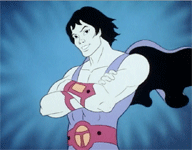
Space Sentinels, a Filmation wonder from 1977 about three cosmic superheroes protecting the Earth from enemy yadda yadda of the week, was the very jewel of my infancy. I loved the music, the glowing launch tubes, the large floaty computer, and even the obligatory annoying Filmation comic side kick, Mo (or to call him by his less affectionate name – Maintenance Operator).

But I’m no longer a little boy. Now I’m a crotchety old man, tied in a bow made of jaded trials and tragic experiences. So I was very wary as to how these fond child based memories would translate into adulthood, and if, indeed, by watching Space Sentinels now, I would tarnish my memory of “then” - if you see what I mean.
This DVD collection has all 13 episodes of The Space Sentinels as well as 5 episodes of a follow up show called Freedom Force that was a component of the Tarzan and the Super Seven show. Bundled with this are a host of special features aimed to appeal at the nostalgia buff, be he casual or hardcore. Filmation has once again offered a rather packed DVD collective. But how does the show itself fare?

I must say I was uncertain at first. I would suggest it would be best to watch several episodes before making judgment on Space Sentinels.

The gaudy suits and rather bland central characters may put the uninitiated off fairly quickly, but if one looks a little deeper there is some good stuff here - and I can say that without fear of being caught in cloud of nostalgia.

Not that I would pretend there weren’t some successful lumps of sentimentality here to warm my cockles. The music is as good as I remember it; a funky yet muted track that never overwhelms the show, but gives it a distinct and consistent aural sound. Yes, the music came flooding back. The animation isn’t quite as technically gifted as later Filmation shows that dabble in rotorscope and overlay effects, but it does have some nice qualities to it. The super computer Sentinel One is a powerful show icon that has stuck with for over two decades and stands up well today.

His animation is far simpler than I remembered, but works just as well. The design and animation for his computer mechanic, Mo, is also nicely visualized. Mo is certainly one of the better attempts at designing a cartoon’s comic relief. A great deal of attention has been taken in rendering a flexible and visually comic character. In fact, it seems more attention was put towards Mo than the team itself.

The basic premise of Space Sentinels is actually more impressive to an adult as it is to a kid. The three superheroes are based in human mythology as indeed are many of the antagonists. The Space Sentinels Hercules, Astraea and Mercury are all based in Greek or Roman mythology, and, as the story goes, their mythological legend comes from the super powers that the Sentinel home planet has bestowed on them. Since then, they’ve lived on Earth, immortal, protecting it from the evil, thus creating the myth of these three Legends.

As the series progresses we find out that there are Sentinels on many planets with similar powers. We even meet some earlier potential Earth sentinels (who again are born from myth). Overall, the background story makes not just for quite a mature premise, but it is an idea that involves itself in the episode storylines, something which I didn’t recall or expect from the show. It was rare for cartoons in the seventies and eighties to really explore the basic fantasy plot premise - especially for a show that was so short lived.

Another impressive element of the narratives is the diversity of the stories and the focus on the plots to carry the tale rather than the characters. You don’t get any storylines that really focus on any of the lead characters as you do in most animation - then and now. No “Orko feeling sorry for himself, goes wandering off and has to be rescued, thereby learning his lesson trusting strangers” tales.
The heroes interact around the plots, rather than the plots interacting around the heroes. In all honesty, in a kid's cartoon of this ilk, it's rather refreshing.

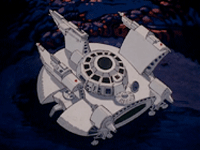
To my pleasure, the stories actually get better as you progress through the series. After a few episodes, the crew go airborne and into space with their spaceship. This adds an extra level of diversity to these fairly simple stories.

Time to name favorites: “The Prime Sentinel” is a tale set in outer space that gives a great deal of back-story to the show premise. Watch out for some alternate galactic Sentinels. “Morpheus: The Sinister Sentinel” offers a little more back-story to the show and while a little slow, does offer a formidable villain. "Space Giant" offers an enjoyable twist and while the “The World Ship” is a little obvious, it has a gentle wrap scene for the series.

As I mentioned before hand, the downside to the show are the lead characters who are never really explored to any satisfactory level and end up feeling rather shallow. Their backgrounds are never referred to, and their relationships never change. However, quite often there are enough plot turns to keep the story interesting without having to rely on the central characters to carry it. Despite this flaw, one has to also acknowledge the multi-racial quality to the heroes. Such ethnic diversity in lead characters was fairly rare, and it’s good to see a show have a lead cast of different races without really falling foul of cliché. Yes, Mercury does martial arts, but beyond that, the Chinese stereotype ends.

A pity that the heroes have so little life as this really is a problem for the show. There is so little chemistry personality wise. Yes, Mercury is wise cracking, Astraea is a cool lead and Hercules is, well, strong, but it really adds up to very little. Sentinel One probably has the most charisma but is stricken with a horrendous monotone that can get a little tiresome. And with no supporting cast beyond Mo and Sentinel One, the cast feels very insular and slightly claustrophobic – immortal life in a spaceship at the bottom of a volcano with Hercules’ muscles, Mercury’s painful jokes and Mo’s painful pratfalls? Hell. True hell.

Nevertheless, The Space Sentinels succeeds more often than it fails. Get past the rather uninteresting heroes, and the stories are rather good and the actual finish is solidly produced. Space Sentinels offers thirteen episodes that are varied in storyline yet consistent in production.

Special features? An odd mix. You’ll find the scripts as a DVD ROM extra – very nice for the hardcore follower. There is also some interesting special footage. There is an animated presentation pilot for the series in its earliest form: The Young Sentinels. It makes for a fairly interesting to watch, particularly in context as a series pitch. More curious is a talent test pilot for the proposed Young Sentinels life action series. I'd say it's definitely worth a watch. It’s played out well and a curiosity in itself.

For the casual buyer, there are some blink-and-you’ll-miss-em documentaries (where the opening and closing sequence seems longer than the interviews) with producer Lou Schemimer, a host of writers and some of the art crew. There really isn’t much to be said about these interviews. They are fun and friendly, but won’t offer any deep insight for anyone beyond a casual viewer.

There is a special “The Magic of Filmation” which is an interesting if slightly indulgent look at the studio behind the show. This is actually quite fascinating, particularly into the creation of the studio. These guys did have some true chutzpah. It’s around thirty minutes in length and has interviews with a variety of Filmation staff members from throughout its history.

The final bonus to this DVD - and I struggle to use the word “bonus” in this case - is the five episodes of Freedom Force, an animated cartoon made a year or so later that also stars Hercules. Well, it stars Hercules' model sheet. His character and voice are rather different. For this reason alone, this DVD has been given a special feature that is about as special as finding a dead fly in one’s soup.

Freedom Force follows the Space Sentinels premise of adapting mythological characters into contemporary animated stories. Unfortunately, unlike Space Sentinels, this has no charm and stories that flow as gracefully as a gangster in concrete boots. It’s a tedious and arbitrary affair. None of the characters really have any relationship to each other, the designs and models are extremely lack luster and really this is a show to watch when drunk, or preferably, when passed out. There are no redeeming features to Freedom Force. Music is average, the voices are a little too hammy and overall it’s the sort of production that blights Formation’s reputation. The only good thing I can say about it is that like Space Sentinels, it goes for ethnic diversity with a range of heroes from different continents. While this is a commendable ideology, it doesn’t make watching it any more exciting that paint drying.

The DVD package is a mix. The inlay is great; it has descriptions for every episode with a little piece of trivia for each. The interactive menus are well presented, if a little sluggish in between episode switches and the overall mix of special features is pleasant though not horrendously inspired. The real let down is the disks themselves - no pictures on these disks. Simply blank faced double sided DVDs. Not a major issue, but visually a little disappointing upon opening.

For all its faults, The Space Sentinels actually lives up to and beyond the nostalgia trip. Sure, it’s not as exciting as it was when I was a kid, but it’s not really produced for adults. That being said, I have more respect for it as an adult, being a little more aware of its mythological roots and appreciating the rather refreshingly plotted pulp action that went over my head as a kid. The characters may be a little drab, but the stories are diverse and interesting enough to mitigate this flaw.

It’s a DVD that shows you some of the best - and worst - of Filmation. Space Sentinels is unique and worth a look if you are into nostalgia trips or curious about kid cartoons of the seventies. Freedom Force is for the hardcore enthusiasts only, and if you are one of those fellows, maybe you should get out more. Come on, guys, it’s bad. Best to remember Freedom Force is merely a bonus, and we can’t get too grumpy over bonus features, can we?

Just remember: thirteen episodes of good to five episodes of bad, still makes this a good DVD collection. I’m glad that Space Sentinels hasn’t let me - or that five-year-old kid that lurks within - down in any way. Good solid animated kid’s fiction - recommended.

Thursday, October 26, 2006

REVIEW: Edible "Oedipus": Classic Animated Short Comes to DVD

[Article written for Toon Zone News - 08.10.06]

Destiny is a funny old thing. It can bring a fountain of joy, a shower of love, a well of happiness, a bucket of mirth.... and so forth.

Of course, destiny can equally damn you to murder your father, marry your mother, endure a sister as your daughter and once again - and so forth. Such outcomes - to my knowledge - are fairly rare.

If we go one step further, such terrible circumstances being combined into one man’s singular destiny are rarer still. So you can’t help but feel a slight twinge of pity for any poor clod that pulls that short a straw.

You can’t help but pity the life of one such poor clod - Oedipus.

Especially when he’s made of potato.

Yes, possibly one of the most tragic myths this world has heard has been respectful condensed into an eight minute mini-epic starring a potato, a piece of broccoli and Billy Dee Williams.

It must have been an honor for Mr. Dee Williams – or “Lando Calrissian” as he’s known to his friends - to play alongside such a fabled and legendary vegetable.

I sincerely hope his role as “unnamed barman number one” thrusts his career back into the limelight. It would be a tragedy if he was outshined by a cast of organic food.

Unfortunately for Mr. Dee Williams, destiny has spoken and indeed in this case, the edible cast is magnificent.

Oedipus is a charming and humorous animated short film by animation director John Wishnow. It takes the classic Greek myth of Oedipus Rex and adapts it cinematically using the aforementioned plethora of vegetables.

For those who fell asleep during history lessons, let me recap in a time shorter than it takes to tell a nourishing mini epic. Try not to fall asleep for a second time.

Oedipus is the son of the King and Queen of Thebes. Upon his father’s discovery that his child was prophesized to kill him and marry his mother, the Queen, Oedipus was sent away to be killed. Through unforeseen circumstance, the boy wasn’t murdered as his parents intended and grew up oblivious to his predicted destiny. Years later, Oedipus meets his father on the road to Thebes and thereby starts the tragic prophecy of a future King who is destined to marry his mother...

The film is a wry jab at Hollywood’s past mythical epics, referencing the likes of “Ben Hur” for immediate comparison. It does this by creating such a grandiose production on an intentionally minimal scale – and you can’t get any more minimal than inanimate foodstuff.

It furthers its Hollywood epical comparisons by employing familiar cinematic techniques with a mocking smile The opening action scene between the potato Oedipus and a stub of Broccoli otherwise known as Laius, his father and King of Thebes, is a very slick and well paced battle. Indeed, if it wasn’t for the consumable nature of the movie’s actors, one could take such direction as seriously as any epic. The angles, direction, postures and action scream “legitimate fight scene” which is only undermined by the fact you are watching two vegetables going at it with kitchen utensils.

As the film moves on, we have a bar scene that resonates with a hundred other similar bar scenes you’ll have encountered on your cinematic journey. Only difference is this one - once again - is populated by vegetables. It’s this dichotomy between absurdity and straight faced direction that makes this such a pleasure to watch; it doesn’t need to try and be funny - it is in its very essence - funny.

You only have to watch the sex scene between Oedipus and his mother, Jocasta - a potato and a tomato - played out in typical Hollywood style - to see how the blend of the preposterous and the creepy can only result in bemused amusement.

There are some nice little pieces of humor injected into the dialogue as well. Some little jabs at just how silly the tale is, particularly how neither mother nor son nor father truly connect the dots in their relationship until it’s too late. However, it is the visuals which tell the story and support the humor rather than the sporadic dialogue.

The production values are very impressive. The character movements are superbly handled and the aforementioned opening battle is testament to this. The colors are rich and welcoming. Vibrant blues, warm golds and regal purples all add to this visually unusual experience and help enforce the homage to classical movie epic. The score cannot be faulted either, coating the film with an ambience of magnificence and majestic energy.

Room for a grumble? There is always room for a grumble, dear reader, though there are few to be found here. In fairness, being just eight minutes long does leave little time to find fault. There is on particular shot I have a small grievance with – Oedipus’ return to Thebes. The entrance shot to the city mimics some of the Hollywood low angle wide shots you see in classic films, with the immediate foreground falling out of focus in favor of the lead character in the far distance. The shot works so far as the narrative flows, but visually it betrays the size of the characters. The out of focus foreground props look miniaturized and while we are dealing with a cast of small vegetables, the illusion of a larger than life scale is never lost barring this one shot. It’s the only reminder of how tiny these lumps of food are.

Beyond that, one might argue the scene in the bar is a little long in relation to the film as a whole and I must admit I found Oedipus’ classical “wreath erection” is a little gratuitous in a film where the visual humor remains fairly subtle - beyond it being filled with a host of stars you probably slipped off your dinner plate and into the dog’s maul the night before. All in all, simply minor niggles.

If you have the spare change to buy the DVD, you’ll find they’ve done their best make it a worthwhile purchase. The Behind the Scenes documentary is edited together with the same slick finish as the movie and offers an engaging visual insight into the work behind this mini epic.

The storyboards are also present on the DVD and edited into film sequence. This is a must watch for any budding director or storyboard artist. Even if you aren’t into film, they are certainly worth a playback as they are beautifully rendered. And being that Oedipus is just an 8 minute mini film, it’s hardly going to take up too much time.

The box and disk are beautifully illustrated though the best part of the whole package is the “action play sets” depicted on the back. They are a wonderful little slight at the crassness of tie-in film merchandise. If you are lucky enough to be one of the first 1000 orders, you get a 35mm piece of film strip. Nice.

It is a fairly pricey DVD for its short contents, but it is well packaged and the film is an internationally award winning piece of animation. The DVD is digitally remastered in High Definition and it does look beautiful on screen.

Yes, it is short. Yes, it stars vegetables. But it does have Billy Dee Williams and in all fairness, his smooth, rich voice does add to the film. I’m glad Mr. Dee Williams took on the challenge. Having to play alongside an internationally award winning mythical vegetable must have taken a lot of courage.

Furthermore, not only does it look impressive on your shelf, its makes for a great way to break the ice at parties, being a great source of amusement and exclamation for all.
Just remember: while some vegetables are considered aphrodisiacs, a film that has a vegetable having sex with their mother, is not. Avoid playing this film on any romantic first dates.

Oedipus is a great little film that any serious animation buffs would be proud to have on their shelf. It is a pricey buy given its short contents but a worthy investment all the same. Look out for the Potato’s next role. Indeed, keep ‘em peeled.

Tuesday, August 29, 2006

REVIEW: Flash" Back: Filmation's Best Returns to DVD


[Article written for Toon Zone News: 07-26-2006]

With little reverence to thirty years of journalistic tradition, I will not begin this review on The New Adventures of Flash Gordon with any attempt to slip in the famous shill cry of “Flash! Ahhhhh.” [Real elegant. -Ed]

For those as vaguely acquainted with Flash Gordon as the mainstream media, a little background seems appropriate. No matter the opinion of pub culture, the campy, creative and oh-so-colorful Dino De Laurentiis movie of 1980 starring Sam J. Jones, Max Von Sydow and most infamously, Brian Blessed, was not the first version of our blonde hero.

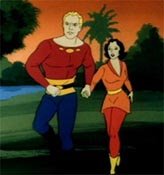
Flash Gordon came to life as a news strip in 1934 thanks to the creative juices of artist Alex Raymond. Flash is an American Polo player and athlete who, along with Dale Arden and the (at first) evil scientist Doctor Hans Zarkov, travel to planet Mongo to fight the imperious forces of Ming the Merciless.

The news strip spawned movie serials, TV shows, radio plays, books and, of course, even more news strips, all of which propelled space adventurer Flash Gordon through many battles with the evil minions of Ming.

Not only did the concept endure, but it was a major influence on contemporary science fiction, with George Lucas citing Gordon as inspiration for the style of Star Wars.

In 1979, Flash Gordon missed becoming a live action TV film by around $30 million. Too expensive to make with actors, Lou Scheimer instead moved towards animation. The end result was an acclaimed feature-length cartoon that was then edited to form the first chapters of the animated serial The New Adventures of Flash Gordon. Its Saturday morning run created a new generation of Flash Gordon fans.

The New Adventures of Flash Gordon was made at Filmation studios, home of the likes of Tarzan, Space Sentinels and, more famously, He-Man and the Masters of the Universe. The show was a two-season affair; the first season was a half-hour weekly serial that played faithfully to the original news strip, the second broke each episode into two parts and moved away from Raymond’s vision to create a more child-friendly format.

There is a lot to be said for this version of Flash Gordon—both as a faithful translation of Raymond’s news strip and as an animated venture. Naturally by today’s standards, the animation does lack pace and versatility, but the show has a lovely blend of such three-dimensional techniques as rotoscoping, hand-painted stop animation footage and moiré effects (the three-dimensional laced energy backgrounds many will remember from He-Man and She-Ra). The combination of colorful backdrops, rotoscoped human movement and rolling vehicles helps create a good Gordon ambience, and atmosphere was a vital ingredient for this cartoon as a great deal had been invested into making it feel like the original strip. As with the news strip, each episode has cliffhangers. Visually, character, vehicle and costume designs mimic the original artwork. On top of this, a lavish score reminiscent of 30s cinema is laced into the show.

So while the animation is indeed slower and less ambitious than that of the show's predecessors and successors, it fits the title perfectly. Much of the original artwork includes realistic proportions and static tableaux, turning the limited animation into something of an advantage. The blend of gentle rotoscoping, colorful geography and careful attention to aesthetics makes this still one of the most authentic adaptations of the original strip.

In plot, too, the first season hews very close to the illustrated tales, significantly raising the standard of the show. “A Planet in Peril,” “Blue Magic” and my favorite from the original news strip, “Tournament of Death,” are some of my personal recommendations from season one. Favorites aside, I don’t feel there is a single episode of the first season that truly lacks luster. The consistency of pacing and quality atmosphere throughout this first season is extremely strong. While all the character designs stay close to the original Raymond strip, one should take special note of the women. In infamous Flash Gordon style, the animated heroines and villainesses of Mongo are faithfully alluring.

The voice casting carries some of Filmation's standard crew: Robert “Tarzan” Ridgely as Flash, Melendy “She-Ra” Britt as Princess Aura, and of course the magical Alan Oppenheimer as Ming the Merciless, a clear precursor to Alan’s later infamous role as Skeletor in He-Man and the Masters of the Universe. The cast—as in most Filmation cartoons—do a variety of voice roles and do a fine job in capturing the spirit of Flash Gordon.

With a mix of faithful stories, solid acting and colorful visuals, Flash Gordon’s first season is very much a family affair—far more so than the second. For a Saturday morning cartoon, it’s surprising how directly these early episodes confront death—though it is the poor minor players who suffer. The poor Hawkmen soldiers seem to get on particularly poorly vis-a-vis constant disintegration.

Yes, the show does rely heavily on stock footage. Be prepared to see reuse of body movements, action scenes and vehicles. I find spotting these instances rather endearing.
Stock footage was also a key element of the old film and television serials, so the budgetary constraint on the animation is in fact accurate. But it is possible to have too much of a bad thing, which brings us to Flash Gordon's second season.

The second season loosened its ties to the original adventures in a play for the children’s market. Afraid another season-long story arc, with week-long gaps between episodes, was economic suicide in an age of syndication and decreasing attention spans, the studio opted for self-contained adventures instead. Episodes shrank in length to two 11-minute segments each, and budgets also dwindled. Occasional repeated footage become reuse of locations and story elements from the first season. As in He-Man and others, this is part of that ineffable Filmation charm, but it does erode the quality of the overall production.

To add insult to injury, season two marks the arrival of a new character. In a ploy used many times before and since, the studio introduced a quirky beast for gratuitous comic relief, named Gremlin. Yes, if the cartoon capers of Scrappy Doo, Godzooky and Orko weren’t enough to fossilize your funny bone and wear out the fast forward button on your remote, Gremlin is here to further the mission to madden. In some ways, Gremlin is the worst of all his kin. At least Scrappy was a dog like Scooby, Godzooky was a dinosaur like Godzilla, and Orko was hardly out of place in a world of spells, magic and blue megalomaniacs who drew the short straw when it came to both fashion and dermatological aesthetics. But Gremlin is not even a Gremlin. He’s a pink, “cute” baby dragon. Sure, Mongo had some weird beasts, some resembling dragons. However, none that I recall were pink, squeaky and astoundingly annoying.

To make things worse, Gremlin gets a firm spotlight in nearly every episode of the second season, a real problem for a cartoon based on a well-established story. For fifty-odd years Flash Gordon had got on fine without a pink dragon, particularly one so infuriatingly springy.

Despite the new format, the pink dragon and the cheaper production values, it is possible to enjoy season two on a simplistic level. Season one is far superior, but in a way, the second season offers a glance at what happens after an epic. In cartoons, it’s rare to even get to the end of an epic before cancellation can wield its unyielding axe. With The New Adventures of Flash Gordon we get more rather than less.

Season one covered much of Raymond’s original concepts and had a great finale. Season two is a lighter affair—aimed at a younger audience—but it has a friendly vibe that is lacking from season one. Season one never stops; it’s non stop action followed by a cliffhanger followed by non-stop action. Sometimes you just wish our heroes get a break from the risks and danger. Well season two offers the audience a far more settled Mongo. Sure, there are 11 minute disasters on occasions, but it’s a fight taken on by a community settled in Arboria rather than a group of fleeing rebels.

I certainly wouldn’t pretend season two is brilliant—or even above average. Its budget is decidedly poor, the inclusion of Gremlin remains intrusive and of course, some of the episodes are insultingly childish. “Micro Menace” is the biggest mess, “Flash Back” strays too far from the source material and “Sir Gremlin” starts well but ends up as a substandard version of season one’s “Blue Magic.” But to counter that, there is a lot of fun to be found in “Gremlin’s Finest Hour,” “The Freedom Balloon” and “Royal Wedding.” Don’t expect any of the stories to stand out—especially compared to season one, but there is a childish simplicity to them that I found rather endearing and it is a chance to see our heroes for just a little longer. Take season two as a bonus; just don’t think too hard about it.

The DVD itself is a treat. It's a beautifully packaged with a nice set of four picture disks. Even the simplest features are very in-depth. The character profiles offer images and model sheets along with a scrolling biography for pretty much the entire cast of the series.

The “Blasting off with Flash Gordon” documentary is interesting enough, offering commentary from a variety of sources. There is some rather blatant promoting going on in this segment, but it doesn’t get in the way too much.

If you are an art fan, there are some nice storyboard-to-footage comparisons for several stock moments. There is also a further set of storyboards as DVD ROM extras as well as scripts and series bible in easy to access PDF format.

On top of all that, there are three commentaries. The season one commentary lands on the first episode and has Executive Producer Lou Scheimer and Assistant Animator Darrel MacNeil. It’s not quite as insightful as I hoped. Much of the background that they explain in this episode is in the DVD documentary. While there are some slightly more in-depth explanations of some of the animated processes used at Filmation, it’s a fairly dry affair.

The second and third commentaries are from season two and are unfortunately done by episode rather than show—meaning each commentary is just eleven minutes long! Writers Tim Ruegger and Michael Reeves explain the details behind the stories for “Sir Gremlin” and “Gremlin’s Finest Hour” respectively. Unfortunately, there isn’t a great deal to be said about season two episodes. They are okay to watch, but the stories are not very complex and often have so little to do with the original Flash Gordon characters that there is very little to talk about. The commentaries as a whole are a little disappointing, but nevertheless there are little tidbits in the three episodes you won’t find on the documentary.

And if all those features weren’t enough to tickle you pink as a Gremlin, there is a bonus feature: episode one of Defenders of the Earth! It's a surprising addition to the set. Yes, the Defenders are lead by an older Flash Gordon, but he’s a very different one to the character presented in The New Adventures of Flash Gordon or the Raymond strips themselves. In fact—shocking as this may be—Defenders of the Earth is even less faithful to Flash Gordon than season two of The New Adventures of Flash Gordon. It even goes so far as to kill Flash’s wife (which we presume is an unnamed Dale Arden) and takes him away from Mongo entirely! It is, however, a fairly faithful slug of eighties cartoon formula. You have your silly comic “Gremlin” variant, the terrible electric eighties score, generic models and a terrible set of protégé children that are attached to the team.

Defenders of the Earth is not nearly as authentic to Raymond’s Flash Gordon, as New Adventures, but some may find it a bit of retro fun and it does make season two of New Adventures look classy in comparison.

Overall this is a great set. Even the DVD’s inlay has individual episode synopsis—and the set even comes with some individual collector cards, just to win over those who are for some reason, determined to keep their money in their wallet.

The stories hold up well, the DVD is neatly packaged and showered with special features that cover every aspect of the show. The quality of the episodes is quite palatable, international fans will be pleased to hear that some of the odd episode coloration seems to have been lost on this region one set.

Be it an introduction into the authentic world of Flash Gordon, a curious glance at a different version of the hero, or simply a worthy addition to a Flash fan’s collection, this is a virtually faultless product that has been put together with thought and care.

In the words of the great Brian Blessed (or was it Vultan? I can never distinguish the two)—“Gordon’s alive!” If you wanted proof, you could fare no better than this great DVD set of Filmation’s best.

Monday, July 31, 2006

REVIEW: Doctor Who: Season 2 - The Impossible Planet/The Satan Pit

Deep in space, an impossible planet orbits a black hole in an impossible way. It emanates an impossible cone of gravity while beknown to the human explorers on its surface, the impossible planet has an impossible, devilish secret.

Impossible, is the theme to “The Impossible Planet/The Satan Pit” two parter. Not just its concept, but its philosophy. This episode is as much about how the Doctor deals with the inexplicable - or should I say, the impossible - as it is an adventure trapped in a scientific absurdity.

The setting for this adventure, the impossible and unnamed planet, is crafted with an eye for detail. The base itself brings back images of all sorts of dirty science fiction TV and film shows. Visually, the story has very intentional ties to Ripley Scott’s “Alien”. As a story, it shifts slightly closer towards the science fiction horror, “Event Horizon”. There is a little of Space:1999 in the base’s external design and I thought the adjoining spacecraft had a little bit of the retro rocket ship from the likes of Buster Crabbe’s “Flash Gordon”. By taking a little from various places in the genre it gives this story its own identity playing homage to the best without mimicking or feeling like a second rate copy.

As with the New Series as a whole, the acting is hard to fault, which in a claustrophobic nightmare as in “The Impossible Planet/The Satan Pit”, is vital. There are few minor characters to draw attention away from the main cast and being a very science fiction orientated story, you HAVE to believe in those actors. There is no question about believability which is testament to the acting and direction.

Helping them along is a wonderful script by Matthew Jones, a veteran writer from the Virgin New Adventure’s era. It has to be said that “The Impossible Planet/The Satan Pit” certainly has a taste of those seventh Doctor novels. However, it also feesl quite “traditional Who” at the same time. This story takes from the classic show in a way I felt “Rise of the Cybermen” failed to suceed. The story doesn’t just take old formulaic ideas and integrate them (my concern with “Rise Of The Cybermen”), it takes classic devices from the old series and uses them in a contemporary context. For instance, the TARDIS is lost within a few minutes. Very traditional Who, but actually there is no specific need to do this with the tenth Doctor. The tradition is there, but upated for the requirements of the story. Iin the sixties, Doctor Who had to find a practical reason as to why the TARDIS team didn’t run away - which often lead to being severed from their route back to the TARDIS - “The Impossible Planet” actually knocks this possibility aside with its teaser - Rose and the Doctor laughing at the very prospect of leaving. Yet, losing the TARDIS early on helps create that helpless environment that is required for the episode.

Furthermore, we also have some death scenes in “The Satan’s Pit” which are very old school Who. Security controller Jefferson stays behind to fight the enemy off and thereby sacrificing his life. Very typical Doctor Who, yet, in “The Satan’s Pit”, the scene uses this formula to focus on the emotional drama. No simple scream to announce the death of the straggler - we see the man and his friends dealing with his choice.

“The Impossible Planet” is a joyous piece of writing. The idea of being caught by a black hole was a premise set up in a similar vein by the aptly titled Disney film “The Black Hole”, however the focus on this story is less on the collapsed star above, but what’s going on below. Rather than simply become a “monster vs human” affair, “The Impossible Planet” rapidly changes direction from science fiction to mythological horror. This movement from one genre to the other is seamless. The “Ood”, a willing slave race, provide the obligatory monster to keep the tension up, but the real monster is the devil in the pit. The scene in which Tobey the archeologist is “infected” by the devil is probably the scariest moment in Doctor Who. What makes it even more impressive is it relies on nothing but the actor and the production crew to create the suspense. No effects, no monsters. It’s just good acting, direction and a deft piece of editing.

The climax to “The Impossible Pit” is one of the best ones of the New Series. As with “Aliens Of London” it’s a multi cliff-hanger, which really does build the tension to impossible levels. It’s only weakness is the resolution is wrapped up rather fast and a little too neatly in “The Satan Pit”

“The Satan Pit” doesn’t start off as strong as “The Impossible Planet” ended, but it makes up for any such weakness by the final act. This episode is Doctor Who at it’s best. We have tension, we action, we have drama. The New Series Doctor Who knows when to lay off the comedy and British eccentricities and there is little of either in “The Satan Pit”. What we do have is a wonderful fusion of drama and character scenes. While Rose has the drama and action, the Doctor has the character moments and the two arcs compliment themselves beautifully.

Rose’s role in “The Satan’s Pit” is probably the best use of the character this series. She gets to work on her own story arc rather than just tagging onto the Doctor’s. Giving both Rose and the Doctor space from each other really helped the characters to breathe. It’s only when they are pulled apart as in this story does one realise how their natural dynamic just suffocates the pair when they are together. My only silly quibble with Rose in this episode was during the finale where she dispatches the monster by blowing out the window with a bolt gun. It’s a nice idea and a lot of fun, but when the villain is strapped next to you, you’d think your instinctive reaction would be to fire it into the villain’s chest not blow open the cabin and undo his belt. Far more dramatic - and I appreciate there is only so much cold blood you can dish out to a companion, but this sort of reaction seems a little out of character for anyone in Rose’s situation! Oh, and while we’re on minor quibbles, a superficial suggestion is for makeup to lighten up on the eyeliner. Rose has black eyes that a panda would envy.

The finale is a great piece of television full of suspence and growing tension. The whole plot resolution was a relief as I was beginning to question some of the episode’s plausibility (if there is any in a story set on an impossible planet to begin with).

The devil is established as such a powerful omnipotent villain, yet when the crew fight back, he goes strangely impotent. Now this happens a lot when shows pit a mighty power against lesser powered heroes; the writer has to de-power or empower one of the two in order to create a victory for the underdog. With the characters successfully fighting back from the might of the Ood, it suddenly feels as if we’ve seen the devil suffer some power withdrawal. Thankfully, the end makes it clear this was never the intention.

With a whole story so steeped in mystery, the audience are kept one step behind which really serves the storyline. This is after all, unusual territory for Doctor Who; no blasé explanation of godly powers, no affirmation that this is an advanced alien.. the details are kept to a minimum all the way to the end. The story, in essense, makes a battle against formula and leaves the audience wondering in which direction it’s going to go: Will it expose the enemy as a powerful alien? Or is this the first unholy terror we’ve seen in Doctor Who?

The story has a great balance between dark and light. It is a tense watch, but the ending has a joyous lift which feels appropriate for the show. I suppose one could see it as a metaphor; escaping the dire gravity of the situation is almost like escaping the Black Hole’s pull.

Throughout, the music is wonderful. A collection of the standard Murray Gold motifs, with a natural earthy mix of strings akin to “Firefly” and Chris Carter’s “Millennium”.

Any grumbles? A couple. The Rose and Doctor relationship explored in “The Impossible Planet” still feels naff. While “The Satan’s Pit” gives us a little glimpse into what the Doctor sees in Rose, she still seems very childish. Her dreams of settling down with the Doctor in this story, the selfish possessiveness of the Time Lord she’s exhibited throughout the season - she doesn’t feel like a character you’d imagine someone as old and well travelled like the Doctor falling for. I suppose one could argue he has so much respect for the instinctive drive for mankind - as referenced a great deal in this story - someone who is so honest to their whims - to the point they are discourteous to others, may be strangely attractive to him. Either way, it’s still not something I’m personally keen on the series exploring. Madame De Pompedeau seemed a more realistic pairing. The romance isn’t the issue - it’s the subject of the romance I question.

[Article for Outpost Gallifrey June 2006]

One grumble we’re sure to hear is how conveniently the Doctor finds the TARDIS after his wonderfully dramatic test of faith in front of the demon. To me, it was a perfect resolution. This story is about the nature of the inexplicable; that there are some things that we can’t explain. Finding the TARDIS shows that same inexplicable circumstances that brings us the devil in this story - only in a more positive form. For me it made the episode, but considering how certain sections of fandom found the lack of science in having a “Impossible Planet” hard to get by, such solutions in “The Satan Pit” are bound to agitate.

An excellent story from start to finish. Best two parter I’ve seen. Yes, I believe it’s better than “The Empty Child”. Tennant is great, Piper does a wonderful job in part two and the whole performance shines. This is truly an ensemble story and no one let’s the side down.

”The Impossible Planet/The Satan Pit” is some scary Doctor Who that mixes wonderful homage and classic Who concepts into a story which feels fresh exciting and brimming with drama. Comparing individual episodes in such a diverse series as Doctor Who is hard, but, this has to be one of the best episodes of Doctor Who - period. Honestly dear fans, we’ve never had it so good.

REVIEW: Out of Steam? Not a Ghost of a Chance!

[Article for Toon Zone News 20.7.06]

A much belated review thanks to some personal physical distress to my hands. Irrelevant as this may seem to you dear reader, it offers me a perfect lead in to my opening for Ghost in the Shell: Stand Alone Complex 2nd GIG Volume 5.

Imagine cybernetics becoming so physically integrated that the only aspect of humanity left is the spirit—or “Ghost”—of the user. Having to write this full review with a physical hand complaint still present, the idea of extreme and endurable prosthetics is very attractive. Not only can you look great—as fans of the story’s heroine, Major Kusanagi, will attest—you’d have the ability to interchange bodies; the power to jack into any electronic network, manipulating or screening anyone else attached; you’d have endurance beyond comparison and thereby hands that don’t suffer discomfort when reviewing screeners. Sounds a perfect world to me, n’est pas?

Any one who has read Masamune’s legendary comic book, Ghost in the Shell or followed the movies and TV series that followed will know the world of the mid 21st century is anything but perfect. Political intrigue, technological mayhem and human greed wrapped tightly by the blur of man and machine. Masamune’s original comic book was a wondrous mix of a dark future painted with an almost whimsical touch of intelligence. It could be gory, it could be humorous, it could be both, but it always treated its audience with respect, and this has been true of its move to animation.

This volume is one of the later ones of the second season of the animated television series. If you’ve not read Ghost in the Shell, or seen any of the animated genres, might be best to go read an article on Mickey Mouse. There is a lot to catch up on and those uneducated in all things cyberpunk might be best enjoying a yarn from Walt’s favorite rodent instead.

This volume contains four episodes, some of which follow the current season arc, some stand alone. I’ll presume that those reading the review of this later volume will be aware of concepts and characters and move straight onto the episodes themselves. If you’ve not had that good fortune, try and keep up.

In actual fact, my DVD player was being cantankerous with the Japanese soundtrack on the screener so I was only able to watch it in the English dub. I’ll presume again that those who have watched previous volumes will know what to expect on this score.

Red Data
“Red Data” is possibly the most unusual of the four episodes. Set in Taiwan, the Major goes on the hunt for Kuze and runs into a young kid who is in trouble with some local gangs. The story follows the season’s Individual Eleven arc but actually proves its worth as a rather gentle character piece; the majority of the story is simply dialogue between the Major and the child. This is certainly an interesting dynamic for Major Kusanagi, who then gets to explore the more maternal aspect of her character. The direction is smooth and the colors are rich. The pacing however is what makes this feel rather special—it just nonchalantly walks through the narrative without falling into any specific formula or expectation. It feels like a chapter of a book rather than an episode of a futuristic anime thriller. The final scenes in the hotel just play so smoothly with an air of intelligence and grace with some lovely dialogue and good characterization.

Trans Parent
A left over story concept from the show’s first season, “Trans Parent” has the Major and Batou on a mission to Berlin to locate the terrorist known as Angel’s Wing. This is a really beautiful stand alone story and almost worth the DVD on its own. You need to understand very little about the character and story background to GitS to enjoy this. The pacing for “Trans Parent” is as with “Red Data,” a confident waltz through this gentle tale. This is very much a Batou adventure and manages to mix a little film noir into the atmosphere thanks to Batou’s internal narrative and an organic soundtrack. The whole tale oozes professionalism. However, when a show lightly touches an alternative genre, it does tend to hit some familiar notes. There are some narrative techniques which are a little formulaic in kind, but in implementation doesn’t harm the story, merely enforcing the cross genre. The ending scene in the church is beautiful even if it’s predictable, proof that a story can fall into certain genre expectations and still deliver.

Chain Reaction
Here we’re moving back to the story arc with something a little more to anime expectations. The pacing has picked up and the action is a little more spotlighted. Nevertheless the characters remain well realized and drama isn’t lost in any of the more action orientated storylines. Not quite as unique as the first two parts but what it does, it does well. The hunt for Kuze works and the finale has a little twist to it which isn’t apparent thanks to some nice visual direction and well developed plot. Not quite as memorable as the first two episodes, but nevertheless a solid piece of storytelling.

Fabricate Fog
“Fabricate Fog” is really a second part to “Chain Reaction,” picking up where the last episode left off. The action is even more at the forefront; however the previous episode did enough to build the foundations to let this ride. There are some nice character scenes in here—particularly among the refugees and Kuze. I really like the Kuze character; it’s rare to have a character act like a megalomaniac, yet have a certain truth and honesty in his desire. This episode does a lot to realize those elements of his character and questions the line between terrorist and freedom fighter. The final few minutes pick up the action and the volume ends on a very different tone to which it started.

The Tachikoma epilogues help add that little comic touch present in the original comic. On a personal note, I’ve always found it a pity that the animation itself keeps so far away from the original touches of abstract humor by Shirow Masamune. It’s an interpretation, but this is one anime which would have benefited from the more comical Japanese visualizations from time to time. It certainly helped the original comic books from becoming too rooted in its own serious agenda.

The DVD features complement the volume, with cast interviews that are surprisingly enjoyable. Often DVD cast interviews can be rather inert affairs, but these are quite informal and having the director Kamiyama as the interviewer helps keep the information relevant and informative.

Overall this is a nice volume that offers a collection of episodes that have a hint of diversity while remaining true to the spirit of Ghost in the Shell and the second season arc. It is not totally inaccessible for new watchers, though clearly it would be better for the uninitiated to start their Ghost in the Shell experience with a DVD or comic book that covers earlier parts of the storyline.