Showing posts with label boxset. Show all posts

Monday, July 06, 2009

"One Piece": Straw Hats off to Third and Fourth Voyage

For Toon Zone News
06-15-2009,

Sailing forth, undaunted by the near-infinite number of episodes to come, I am lured in by One Piece, as a sailor is lured by a siren. The One Piece: Second Voyage DVD boxset ended on a nail-biting cliff-hanger, but and now we're back to finish off season one (and begin season two as well!) with One Piece: Third Voyage and One Piece: Fourth Voyage.

For those less in the know than me, One Piece is an anime serial authentically translated from its manga origins. It regales with the tale of a young pirate who seeks to sail the dangerous Grand Line in search of the fabled One Piece. Possessing this treasure is said to rank you as "King of the Pirates". Along the way, Luffy picks up (and occasionally drops off) a menagerie of odd crewmates, the Straw Hats, each with a curious longing and particular ability. The first season establishes his core crew through its run of forty-seven episodes.

My research has only been recreational, but it appears to me that the differences between show and comic, in content and style, are few and far between. In the early stages of the story (yes, the Third Voyage starts at episode 27, and that is very early for One Piece) we are still exploring our central characters. This hero exploration doesn't end until half-way through the fourth box-set with Nami's arc.

What makes this show such a popular affair is hard to pin down. I doubt it is a widespread interest in pirates; aside from Pirates of the Caribbean (a film that owes its success more to a blend of Disney ride and Depp than the pirate genre), pirates don't tend to be popular in contemporary media. Yet somehow One Piece succeeds in breathing life into a genre that has shown very little measure of success since Jim Hawkins set sail for Treasure Island. I think the magic ingredients don't come from any single element. One Piece is a multiplicity of originality, great characters, action, drama and humour—and it's never quite clear where or how the story is going to go from episode to episode.

As much as I'd like to find an excuse to criticise Third Voyage (and thereby at least look like I am fulfilling my criteria as an objective and non-biased reviewer), but I really am hard pressed to find anything to complain about, and those things I did find are rectified in the fourth boxset. For instance, the go-happy theme tune that continues through the third boxset—which I've always disliked—disappears during the fourth. How can you fault a show that clearly not only performs, but reads minds?

Well, Third Voyage does suffer from an incidental and unfortunate dearth of Luffy, who spends a great deal of the set traveling from plot arena A to plot arena B. So the middle episodes of Third Voyage do feel a little empty—but a diamond remains a diamond no matter how you cut it. Moreover, Luffy's adventures at the beginning and end of this set carry more energy and zing that the bastard child of sugar and caffeine. One Piece is more than Luffy, but I doubt it would be quite as unique and memorable without him.

Third Voyage is a strong collection of episodes that delves deeper into the world and the central characters of One Piece. The back-story to Nami proves surprisingly tragic; the Fishmen are seemingly unbeatable as an adversary; and there are deep pockets of humour found everywhere. And who cannot but feel a surge of pleasure when Luffy takes his passion for his crew to the nth degree in some violent and often shockingly bloody manoeuvres?

Fourth Voyage manages to excel even Third. This final first season boxset carries a brilliant run of stories. Partly this is because the series begins to move away from the more formulaic stories it has featured. After the Fourth Voyage wraps up the Nami story-arc, we are given an unusual yet relevant array of single character episodes that not only give our heroes but the audience too a little time for recuperation. In fact, we even move away from the crew for the first time and focus on the antics and situation of other One Piece characters. I found this change both refreshing and enjoyable—particularly the escapades of Captain Buggy which at one point made me, dare I say it, "LOL".

The final adventure on the disk (and the beginning of second season) brings the crew to the last town before the Grand Line and again the formula is shattered somewhat by a whole menagerie of storylines, character moments and comedy. Furthermore, this arc avoids the battle-come-verbal sparring contest and—shock horror—Luffy doesn't save the day as usual. So there some very surprising twists as the show progresses into its second term that pretty much demolishing the only criticism I've been able to muster in fifty-three episodes.

The DVD packaging for all the Voyages remain consistent throughout, and again the marathon option is present so you can watch the show without credits and recaps. As with the previous two boxsets, there is a single commentary track on each boxset—both are highly enjoyable. Third Voyage's commentary is with the buoyant Eric Vale (Sanji) and the Fourth Voyage features the lovely Luci Christian (Nami). Both are hosted by ADR director Mike MacFarland. While mentioning the voices, a quick kudos to the whole of FUNimation's voice cast for One Piece who deliver their lines with little difficulty managing to bridge the show's dramatic spectrum.

As I'm sure 80% of those reading this knew before myself, One Piece is really the king of anime. It's a wide, open genre, but I don't think I've experienced such a consistent gem from the East. It can be funny, it can be very bloody (strutting in its naked, uncensored glory) and strangely poignant.

Hyperbole as my friend, this is the magnum opus of Eastern anime, neatly drawing from all the necessary attributes of drama to make a solid, unbeatable package. If you didn't know it already, this is a show that keeps going from strength to strength and one day may become a street corner substitute for the narcotics trade. Yes, gushing aside, it's that good. Go score yourself some One Piece.

Thursday, March 08, 2007

REVIEW: She-Ra DVD Boxset Volume One

[Article for Toon Zone News: 30.12.06]

Ah, the good old days. Home-baked bread, kids on BMXs, Duran Duran booming out of the stereo and of course, an abundance of cheap and cheerful Filmation cartoons.

And that was just last Thursday.

For once again I'm back on the Filmation DVD box sets, and this time we're off to experience one of Filmation's more famous mainstream offerings: She-Ra Princess of Power, which in box set context has the less catchy title of She-Ra Princess of Power: Season One, Volume One.
The story? What, you don't know? Okay, imagine a world called Eternia. It is a planet swamped in magic, high technology, and simplistic morality. It is protected by a man with a magical sword, furry tights, and the most bizarre blend of blond hair and dark tan the universe has ever seen. His name is He-Man.

Imagine this world of Eternia is also a wonderful platform for selling toys to TV-fixated male kiddies for large sums of parental cash. Imagine it? You've probably experienced it at one end or the other. Yes, Eternia is a world that, among others, made a horde of toy owners and studio executives very, very happy.

Now imagine that this world requires a counterpart—particularly as Eternia's financial lifespan is coming to an end. Enter Etheria! It's a girl's world with girly magic, girly unicorns, and girly women who fight evil monsters while the girly men scrub the dishes at home. It is a good world and it's enjoyed by many, though not quite as many as Eternia was. Nevertheless it brings joy, particularly to the aforementioned toy manufacturers and studio executives.

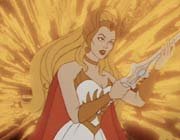
At the center of Etheria is She-Ra, He-Man's twin sister. Perhaps to her disappointment, she hasn't quite got the tan her brother’s managed, but as compensation, she does have lots of exciting girly powers. Alongside the Princess of Power is a group of plucky freedom fighters who aim to overthrow the tyrannical Horde, a group of alien invaders who have control of Etheria. Let the battle begin!

At a basic level, She-Ra Princess of Power differs little from its sibling series. They share the same animation style, voice artists and audio sound banks; on a story level, both offer moral tales that pit honest, heroic characters against incompetent, evil monsters; and both titles offer a simple message that their viewers can contextualize to real-life situations. However, on a closer look, there is a fair bit separating the two.

First, the actual overall scenario for She-Ra Princess of Power is a little less of a fairy tale than He-Man and the Masters of the Universe. While He-Man lives in a kind and honest kingdom ruled by a kind and honest King and Queen who are occasionally threatened by some silly fool, She-Ra lives in a world of oppression where freedom is the honest man's ultimate prize. In She-Ra, there is no even playing ground between good and evil: evil won before the series began, and it's a fight to get a foothold against the towering dominance of the Horde.

Naturally, She-Ra Princess of Power avoids letting the subject of forced oppression create too much of a dampener on the cartoon fun, but it's an issue that is rarely ignored. The show takes the question of freedom and the rights of the individual very seriously, occasionally placing mature issues at the center of its episodes. "Burning Books" is one episode on this box-set that, as its title suggests, has a close parallel in recent history. "Lost for Words" is a rather literal metaphor for the voice of resistance. And "The Price of Freedom" asks how far the value of freedom truly extends.

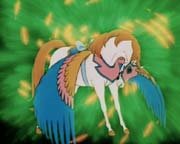
She-Ra's other major distinction from He-Man comes in its target audience. This is undeniably a girl-oriented production, as the creators themselves attest. In fact, the show has exactly what a girl would want: a talking horse. A talking, flying horse. A talking, flying unicorn horse. A talking, flying unicorn horse with multicolored wings. As the example suggests, it's a no-holds-barred pitch at the female demographic. Adding more to the G-Factor, we have a heroine who can communicate with animals as well as heal them. Throw in a cute owl, a dotty witch and the most effeminate male sidekick cartoons have yet to see, and you have the perfect girl action cartoon. On the commentary track, staff writer J. Michael Straczynski (a familiar name to Babylon 5, Fantastic Four and Spider-Man fans) mentions that Filmation brought in consultants to help design the show, and that one of their key concerns was that the heroine not hit anyone. Sure enough, you'll rarely spot She-Ra actually attacking anyone on screen.

Wisely, though, Filmation didn't ignore their already present male fanbase, and so they incorporated the already planned He-Man toy-line "The Horde" into She-Ra. This helped balance the show's character and give it a little more male orientation. Yes, Hordak and his cronies are an excellent counterpoint to the female-focused world of She-Ra. If She-Ra and the great rebellion are the dream of girls, the dirty mess of gadgets, monsters and transforming robots can only be the boy's sandbox. This again marks an interesting contrast between the sibling shows. Where He-Man and the Masters of the Universe blended magic and technology, She-Ra Princess of Power pitted the two against each other.

The stories on this first volume of season one—a staggering 32 episodes—make for a great watch. I was most impressed by the production efforts to give Etheria its own identity. That effort is obvious visually (and if that doesn’t convince you, the 97-page PDF series bible included on the disk set should be a further clue). In She-Ra there is real internal consistency. We have a world of different kingdoms with set characters in each. As the series unfolds we get to see a little more background to some of these places and the people that inhabit them. All this supports the basic principle of the show: the fight for freedom. By giving Etheria set places, it creates a chessboard for its pieces, and the battle becomes more real. That's not to say that there is any particular arc to these established locations and characters, but this focus on consistency really helps give the theme of occupation credibility, even when the theme isn't explored to any great depth.

The stories themselves are more character-oriented than in He-Man. You'll notice a greater mix of superfluous interaction and comic interplay. I found these plot-free inserts a refreshing change of pace, though occasionally they made the stories feel a little uneven.

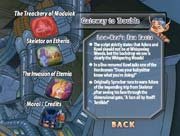
Episodes to watch out for? Don't skip "The Price of Freedom,” which is one of many He-Man crossovers on the box-set and certainly the most adult and challenging story of them all. If you are looking for comedy, "Gateway to Trouble" has some wonderful scenes between its guest star, Skeletor, and the evil Hordak. For gentle moral action, watch "The Stone in the Sword" or "The Peril of Whispering Woods." Of course, one cannot forget to mention the excellent five episodes that launch the series (and made up the He-Man and She-Ra movie, "Secret of the Sword"). You won't find many animated series introductions that establish a show as effectively as that story.

So what about the DVD box set itself? It's a great presentation that folds out with a richly colored panel of character images, and the disk prints themselves are beautifully rendered to match the panels that support them. The interactive DVD menus are well constructed, with some effective music loops and busy presentations. There are three different interactive menus on the six disks.

The episodes, as with Filmation's Flash Gordon recent full set release, have episode synopsis for each interactive episode selection. Furthermore, the chapter selection has a great little smattering of episode facts.

The extra disk of features is up to Filmation's usual standard. While the documentary is a fairly pedestrian affair so far as information goes, it does have an abundance of interviews from the production team and spans a decent duration. The character/location biographies are rich in both content and presentation, offering more detail than the previous Filmation DVDs I've seen.

For the CD-ROM owner, there is a fantastic wealth of PDF files, including not only the gigantic series bible but also a colouring book and the "Secret of the Sword" comic (a heavily edited adaptation of the aforementioned movie). There is also a collection of selected scripts to peruse. For the kids there is an interactive game and for the collector some artist trading cards. On top of all that you have the standard image gallery as well as a fantastic storyboard-to-episode comparison.

There are only two commentaries: "King Miro's Journey" with writer J Michael Straczynski and storyboard artist Micheal Swanigan, and "The Sea Hawk" with writer Larry Ditillio and editor Rick Gehr. The former is far more enjoyable than the latter, which is rather dry, but both are worth listening to.

Downsides? None to the box set itself, beyond the shortage of commentaries. The set is finely presented, easy to navigate, and chockfull of cool features. The stories themselves are also a solid collection. I can't even whine about the obligatory "Filmation fun" character hogging the limelight, as there is no such character in She-Ra! Yes, no Orko, Gremlin or MO. The nearest comparison is Kowl the big-eared owl, but his cynicism and smart-aleck quips at the fluff-for-brains archer, Bow, make for a true treat.

Aside from Hordak, the Horde aren't particularly amazing, but then, aside from Skeletor, He-Man's menagerie was fairly dull. Shadoweaver is just another version of Evil Lynn, though her relationship with Hordak proves surprisingly complex (see "A Loss for Words" and "The Eldritch Mist"). Imp is annoying but again has a curious relationship with Hordak. The rest are fairly forgettable, except for Mantenna. Never has a Filmation henchman had it so hard at the hand of his master.

From a production perspective, the glory of Filmation is there. There is great comfort to be found in the visual and aural predictability of stock animation and music. I would certainly buy any He-Man or She-Ra soundtrack if one were ever produced. The scores are amazingly effective and perfectly blend ambiance and action.

The biggest production hitch is with the voice artists. Their work is effective but lacks diversity. In fact, a great many are done by Filmation’s head honcho, Lou Schiemer (infamously Orko from He-Man). Unlike the pleasure found from the repetition of stock animation and music, a lack of diversity on the vocal track can be frustrating. Turn you eyes away from the screen and you'll be hard pressed to know whether that's Grizlor or a villager speaking. Sometimes the same electronic intonation is added to both, and this can be very confusing if you have the show on in the background. The stories may be fairly simple, but the lack of voices mean you have to pay attention!

Overall, this is another great Filmation box set, especially for nostalgic collectors. She-Ra is sorely under-rated, particularly beside its big brother, He-Man. That’s a shame, as She-Ra is a solid, well-written and ideology-focused universe. It might not give us any answers to our world's topical problems, but it’s a friendly reminder that freedom is something that should never be taken for granted. I think that's a message we can all appreciate, and She-Ra Princess of Power Season One Volume One is certainly an enjoyable way to experience it.