Showing posts with label DVD. Show all posts

Monday, July 06, 2009

"One Piece": Straw Hats off to Third and Fourth Voyage

For Toon Zone News
06-15-2009,

Sailing forth, undaunted by the near-infinite number of episodes to come, I am lured in by One Piece, as a sailor is lured by a siren. The One Piece: Second Voyage DVD boxset ended on a nail-biting cliff-hanger, but and now we're back to finish off season one (and begin season two as well!) with One Piece: Third Voyage and One Piece: Fourth Voyage.

For those less in the know than me, One Piece is an anime serial authentically translated from its manga origins. It regales with the tale of a young pirate who seeks to sail the dangerous Grand Line in search of the fabled One Piece. Possessing this treasure is said to rank you as "King of the Pirates". Along the way, Luffy picks up (and occasionally drops off) a menagerie of odd crewmates, the Straw Hats, each with a curious longing and particular ability. The first season establishes his core crew through its run of forty-seven episodes.

My research has only been recreational, but it appears to me that the differences between show and comic, in content and style, are few and far between. In the early stages of the story (yes, the Third Voyage starts at episode 27, and that is very early for One Piece) we are still exploring our central characters. This hero exploration doesn't end until half-way through the fourth box-set with Nami's arc.

What makes this show such a popular affair is hard to pin down. I doubt it is a widespread interest in pirates; aside from Pirates of the Caribbean (a film that owes its success more to a blend of Disney ride and Depp than the pirate genre), pirates don't tend to be popular in contemporary media. Yet somehow One Piece succeeds in breathing life into a genre that has shown very little measure of success since Jim Hawkins set sail for Treasure Island. I think the magic ingredients don't come from any single element. One Piece is a multiplicity of originality, great characters, action, drama and humour—and it's never quite clear where or how the story is going to go from episode to episode.

As much as I'd like to find an excuse to criticise Third Voyage (and thereby at least look like I am fulfilling my criteria as an objective and non-biased reviewer), but I really am hard pressed to find anything to complain about, and those things I did find are rectified in the fourth boxset. For instance, the go-happy theme tune that continues through the third boxset—which I've always disliked—disappears during the fourth. How can you fault a show that clearly not only performs, but reads minds?

Well, Third Voyage does suffer from an incidental and unfortunate dearth of Luffy, who spends a great deal of the set traveling from plot arena A to plot arena B. So the middle episodes of Third Voyage do feel a little empty—but a diamond remains a diamond no matter how you cut it. Moreover, Luffy's adventures at the beginning and end of this set carry more energy and zing that the bastard child of sugar and caffeine. One Piece is more than Luffy, but I doubt it would be quite as unique and memorable without him.

Third Voyage is a strong collection of episodes that delves deeper into the world and the central characters of One Piece. The back-story to Nami proves surprisingly tragic; the Fishmen are seemingly unbeatable as an adversary; and there are deep pockets of humour found everywhere. And who cannot but feel a surge of pleasure when Luffy takes his passion for his crew to the nth degree in some violent and often shockingly bloody manoeuvres?

Fourth Voyage manages to excel even Third. This final first season boxset carries a brilliant run of stories. Partly this is because the series begins to move away from the more formulaic stories it has featured. After the Fourth Voyage wraps up the Nami story-arc, we are given an unusual yet relevant array of single character episodes that not only give our heroes but the audience too a little time for recuperation. In fact, we even move away from the crew for the first time and focus on the antics and situation of other One Piece characters. I found this change both refreshing and enjoyable—particularly the escapades of Captain Buggy which at one point made me, dare I say it, "LOL".

The final adventure on the disk (and the beginning of second season) brings the crew to the last town before the Grand Line and again the formula is shattered somewhat by a whole menagerie of storylines, character moments and comedy. Furthermore, this arc avoids the battle-come-verbal sparring contest and—shock horror—Luffy doesn't save the day as usual. So there some very surprising twists as the show progresses into its second term that pretty much demolishing the only criticism I've been able to muster in fifty-three episodes.

The DVD packaging for all the Voyages remain consistent throughout, and again the marathon option is present so you can watch the show without credits and recaps. As with the previous two boxsets, there is a single commentary track on each boxset—both are highly enjoyable. Third Voyage's commentary is with the buoyant Eric Vale (Sanji) and the Fourth Voyage features the lovely Luci Christian (Nami). Both are hosted by ADR director Mike MacFarland. While mentioning the voices, a quick kudos to the whole of FUNimation's voice cast for One Piece who deliver their lines with little difficulty managing to bridge the show's dramatic spectrum.

As I'm sure 80% of those reading this knew before myself, One Piece is really the king of anime. It's a wide, open genre, but I don't think I've experienced such a consistent gem from the East. It can be funny, it can be very bloody (strutting in its naked, uncensored glory) and strangely poignant.

Hyperbole as my friend, this is the magnum opus of Eastern anime, neatly drawing from all the necessary attributes of drama to make a solid, unbeatable package. If you didn't know it already, this is a show that keeps going from strength to strength and one day may become a street corner substitute for the narcotics trade. Yes, gushing aside, it's that good. Go score yourself some One Piece.

Thursday, July 10, 2008

M.A.S.K Volume 2 confirmed!

After a long wait, the UK region 2 DVD of M.A.S.K is almost confirmed as a go! This DVD will carry the remainder of season one and the short lived season 2.

I'll be doing the cover, interior artwork and there is some talk (but nothing definite) of a special feature that might involve yours truly. All is subject to the usual gremlins that can change, bugger or halt the release of a product. Should be looking at starting work soon on the title!

When the final definitive 'yes' comes through, I'll let you know!

Tuesday, January 15, 2008

REVIEW: Mad For "Mushi-Shi

[Article written for Toon Zone News 1.15.08]

It sometimes seems that Japanese animation ranges over a smaller field than you might hope. Fighting. Big breasts. Confused young protagonists. Big breasts. Naive females with big breasts. More fighting. Comical sweat drops, big breasts and some more fighting for the sake of naive women with big breasts.

So if you've had enough of the ka-hooie ka-zookas that litter manga cartoons, come take a gander at FUNimation's Mushi-Shi (or in English, Mushi-Master). I spent the first chapter waiting for the young male protagonist, the silly battles, and the overlarge body bopples to appear. By and large, they didn't, which was a refreshing surprise.

So if it's not about the usual stuff, what is it about? That, it proves, is one of the beauties of Mushi-Shi—you really don't know what you're in for. Even after it starts, the show's enigmatic tone will keep you puzzled but expectant.

Basically, Mushi-Shi is a collection of individual tales centering on the mysterious Mushi-Master, Ginko. The Mushi themselves are a fairly vague entity, but they are, at their simplest, the closest thing there is to life in its purist form: a level of existence that transcends the mortal world and lives somewhere figuratively deep beneath it. Sometimes they are visible, sometimes they are not. How they affect the inhabitants of our world differs from story to story, as they are not one simple strain of life, but a pure form of life that has many facets and faces. They are neither good nor evil, but their existence can be a curse or blessing to those they infect or co-exist with. As a result, each tale in this collection centers on a different dilemma presented by the fusion of man and Mushi, one that often requires the Mushi-Master's intervention to strike a balance between the two. The result is something like a fairy tale, though without the vile enemies or earnest heroes.

Each story has its own special charm. "The Green Seat" (the opening story on volume 1) is a simple yet beautiful tale about a grandmother and grandson. "The Pillow Pathway" is a dark fairy tale with an Aesopian tone. "Tender Horns" and "The Light of the Eyelid" both feature children afflicted by Mushi with sensory damage, but the relationships within the two tales are very different. "The Traveling Swamp," though also the most Ginko-orientated fantasy on the first disc, is about a fantastical lady trapped in the moving Mushi-Swamp.

The third volume is just as consistent as the first at fusing fairy tale, tragedy and beauty in a unique and magical way, with "Inside the Cage," a beautiful yet bizarre tale that binds man, woman, and bamboo into one close knit mystery, possibly being my favourite episode on the two discs. The stories on volume three, meanwhile, begin to unravel some of the mysteries about Ginko, with "One Eyed Fish" pretty much laying bare the foundations of his character. If in retrospect it becomes less enchanting (you'd be Mushi in the head if you can't work out where it is going within the first ten minutes), it remains a poignant drama, and its substitution of tragedy for enigma in Ginko's character is a worthwhile exchange.

The stories don't come with much exposition. I find that adds to the show's magic, but others might be frustrated. Sometimes you just can't keep up: I defy anyone to watch "The Sleeping Mountain" and guess where it is going. And sometimes the questions remain even when the story is over; not everything will be clear the first time round.

The animation is magnificent throughout, with the direction and pace retaining a maturity that is rare in commercial animation. While the art and design is beautiful, you never feel it trying to overshadow the story. Only in "The Light of the Eyelid," when the animation, though still hand-drawn, begins to resemble computer imaging, do the visuals fall out of equilibrium. The music retains a dramatic subtlety, except for the Mushi-shi theme track which, while fairly gentle, lacks the subtlety found in the rest of the show. The Western vocal tracks are also good, with Ginko's VA in particular associating believably with the Japanese character.

Mushi-Shi Volume 1 comes lavishly packaged in a delightfully designed box that can hold the entire season; included also is a postcard and a wonderful booklet that explains in depth some the background and design in the show. Further volumes contain a free postcard and inlay booklet of the same style. The packaging retains the quality of initial starter pack. The interactive DVD mechanics are simple yet effective (as I like it), with two casual interviews (one with the voice actor for Ginko and one with the director), a peek around the production offices, the chance to listen to the opening and closing theme songs without text, and the obligatory trailers. In fact, the only liability is the mandatory single trailer at the beginning of each disk—you'll find no way to circumnavigate it.

I wish I knew more about Yuki Urushibara’s original. Quite how accurate this adaptation is, I don't know. But if the manga have anything near the series' quality (and being the original medium, I'm sure they do), they'd be well worth purchasing.

If you are looking for a gentle exploration of Japanese fantasy, Mushi-Shi is for you: mature in its storytelling yet with a childlike innocence to its content. With a consistent, earthy vision, Mushi-Shi is one of the more unique and enchanting animated series I've seen come out of Japan in a long time.

Monday, October 08, 2007

Sabian, Bryar and M.A.S.K

Want some more McLean? Head to your local Sabian dealer!

Sabian.com
(US & Canada only)

The competition rules etc are on-site. It's a comic page which is the basis for a competition by Sabian, maker of those massively popular rawk cymbals.

Not only do selected Sabian dealers have the comic page by myself, in which you finish the story, but there is also a chance to meet My Chemical
Romance drummer, Bob Bryar! Who could resist? I mean, another piece of McLean and a chance to get a drum lesson with some drum legend from a rather popular rock beat combo?

If I hadn't drawn it, and I lived in the US, or I lived in Canada, I would get myself a
piece of myself.

In other news, the region 2 release of M.A.S.K (which I did the cover for), is delayed till November, but hey, don't you have enough McLean for this month?

***

With that shameless plug out of the way, what has McLean been up to? What does McLean recommend?

Well McLean had a rather disturbing loss of screeners this month. Okay, he has a pile mounting up to review for my editor, but he had more on the way which would have fitted with those he had to review. And what happens? Mr Postman, in his eagerness to thieve, opened the package, took the DVDs, and passed the empty jiffy onwards through the postal system.

Now, I appreciate that some postal workers may indeed be on low wages, but I can assure you Beck Vol 3 isn't going to get you anything but a DVD case in the face if it was presented to any nephew for a Birthday present. That's not to say it's bad, but of selective taste, and the third volume of a low key anime release isn't going to get you proud eyes.

Other than that, thoroughly enjoying some James Herriot in book form, made more interesting by a recent trip to the James Herriot museum found in Thirsk, Yorkshire. Interestingly, the fictitiously village of Darrowby, for which Thirsk was the basis, is remarkably similar, right down to the vet's location, and the details of the house. I recommend a visit to anyone who is lurking between Durham and York. Fascinating stuff.

Getting a little more into Heroes, but still not quite sure what the fuss is about. Same with Catch 22, a book which has gripped the world by is failing to grip me. Granted, I'm not far into it, but if it wasn't such a famous, influential classic, I'd have put it down by now.

Been listening to the Foo Fighters newest offering. Some catchy moments, but Mr Foo is getting awfully predictable in his work. You can tell where each song is going to go. Still, not terrible.

Finally, I'm looking at moving my off rumoured "Pandemonium" project to novel form. Yes, I'm going to give a go at writing a book. Having written the Batman DKA story through my student time (and surprisingly capturing the interest of literally millions across the world) I feel the urge to try a project which is solely writing, and allow any past time artwork to be focused on other projects. I just feel there is enough substance there to push it into a richer medium, and a more mainstream one too (there are far more publishers of books than comics). Posted, keep you, I will.

Tuesday, August 07, 2007

REVIEW: Mongolian Chop Suey: "Beck" on Form

[ARTICLE written for Toon Zone News: 06.08.07]

BECK: Mongolian Chop Squad is an odd beast: an anime ambiguity, a musical misfit, a punk peculiarity. It does come with a free plectrum, though.

If you pick up this DVD while looking for the standard anime manga attributes—over-the-top fights; large breasts; big explosions; big, big guns—you are clearly so far from the beaten track you might as well pull out your eyes and slip in a pair of rocks in their place. If you are looking for a piece of Japanese anime that feels culturally alien to your Western environment, indulging in Eastern anthropology and archetypes, again, let me pass you them rocks.

However, if you are looking for a gently paced character drama about some Japanese kids aspiring to form a popular rock beat combo (or for a free plectrum), then eyes back in, my friend, as you've picked up the right box.

This is the first volume of the animation adaptation of Harold Sakuishi graphic adventures, first published in Monthly Shōnen Magazine. It contains five episodes of the 26-episode series, and the aforementioned free plectrum.

The story revolves around a 14-year-old Japanese lad called Yukio (Koyuki to his friends), who through a series of mishaps and good fortune, finds himself unexpectedly heading into that crazy, rebellious world of rock and roll, though not quite in the way you might expect. The first five episodes unfold at a very gentle pace. Music doesn't really become a driving force until part three, and even then the story is not hostage to its musical background. Character interaction takes center stage in these opening episodes, and to some extent that helps this story avoid some of the clichés you so often seen when rock is portrayed in television and film. Bands are as much internally political as they are musical—finding the balance of skills and egos is difficult in real life—and this is an aspect that the show seems committed to exploring.

Yes, it does have some formulaic archetypes, some of which will be familiar to anyone who has watched more than a couple of Japanese animations. Koyuki is the typical "ordinary" Japanese kid who is more reactive than proactive and trapped by the whims and behavior of the other characters. We also have the two love interests: the hot headed, exciting rock chick, and the cute childhood friend Koyuki has long crushed on. We have the rough-edged friend playing the "cool loner" character type, and the standard comic relief guy. And one can't help feeling that, as with so many Shōnen, the protagonist is a cipher onto which certain audience members are meant to project their own insecurities, all of which can then be given a positive resolution in a fantasy environment. Those viewers without such insecurities, on the other hand, might find Koyuki's cautious character irritating and the romantic interest shown by his beautiful lady friends utterly, utterly bewildering.

But I'll admit to enjoying the show's attention to musical detail. Having spent a fair amount time in music myself, I was pleased to see it take many technical elements more seriously than most Western films and television do. It gets the educational aspects right: the use of bar chords (which are visualized accurately); the blisters you get on your fingers when you are starting to learn; and the fact that moving the student to a live performance does very often increase learning potential. The scenes depicting rock gigs are also very true to form, with the atmosphere, technical elements and acoustics all spot on. On occasion it does indulge in some unrealistic conceits (Koyuki's untrained voice sounds like a trained singer in the American version, and his ability to play the guitar and sing comes a little too easy), but the balance between realism and the tricks needed to make the story more interesting are pretty well balanced. The animation and backdrops also work particularly well and, again, show a remarkable attention to detail. You can, for instance, feel the weight of the guitars the characters are holding, which is not something I've often noticed animation getting right.

Despite these strengths, FUNimation's westernized adaptation of Beck is a mixed beast, just like the cartoon canine character the band is named after, with some important aspects getting lost in translation. Some of this is discussed in the DVD's key special feature, the FUNimation director's commentary, which focuses on the fascinating difficulties the American adaptors had in finding a balance between the tale's original cultural roots and the need to place the story in a more Westernized context. They have done a very good job of this: too good of a job, in fact, as it has been too Westernized in places. The American English spoken by the native Japanese teens, for instance, actually sounds more American that that spoken by two characters who have spent a great deal of time in New York. For me, there was a slight imbalance between cultural identities which blurred some of the story elements.

The DVD comes with an adequate array of extras: the aforementioned commentary (which is an interesting listen), a music video (which did not tickle my aural taste buds) and clean versions of the opening and closing credits. Pity we have the mandatory trailer tacked on the front, making me yearn for the days of VHS once more.

Overall, this is a very well realized piece of Shōnen that uses a musical backdrop for a character drama about respect and understanding. The pace might be a little slow for some, and the FUNimation edit may seem a little crass in places, but generally this is a story that could be an enjoyable little piece of light drama.

And in case you forgot, it also comes with a free Beck plectrum. With any luck, future volumes will have the same gift, as you're almost guaranteed to have lost that little piece of plastic in between the floorboards by the next release.

Monday, July 02, 2007

REVIEW: "Sword of Storms": Heaven-Sent Hellboy

[article written for Toon Zone News - 06-11-2007]

Before we delve into our little tête à tête, dear reader, let me make one thing clear: I am a huge fan of the Big Red Devil excellence that wasn't Hellboy.

In recent years, I've been a divided boy when it comes to Hellboy. I have always been a great fan of the concept and found the comic Hellboy a wonderful slice of mythological horror fused with contemporary humor and rich comic-genre indulgences. This Hellboy was unique: visually, narratively and characteristically. But I thought the movie—despite the handiwork of creator Mignola and the film master Del Toro—both ugly and disappointing: it was a substandard conspiracy-driven mishmash of Hellboy characters, all of which had been thrust through the Hollywood blender. Despite fine work by Ron Perlman, Doug Jones and Selma Blair, it managed to focus on every attribute from the book that would have best been avoided in a movie. It not only failed as a film but failed to capture what I found so wonderful and unique in Mignola's original comic work.

In fact, it did a lot to sour me on the very concept.

So with Hellboy: Sword of Storms, we have a full-length animated feature that could go either way with this dainty reviewer. Would it bring Hellboy back to its roots, or would it continue the drudgy film? Given that it has creative elements from both visions, I could see it going either way. Fortunately, it manages to combine the best features of both.

From the film it borrows an excellent set of voice artists. Special doff of the ol' hat to Doug Jones, who does a wonderful voice for Abe Sapien, one that doesn't attempt to copy David Hyde Pierce. Mignola was also intimately involved with the production and the story, and if what he says on the DVD is true, he was given much freer reign.

So it is no surprise that the story of Sword of Storms is very much more the kind of affair you'd expect from the comic: Hellboy has to protect a Japanese sword that has been fused with two ancient Japanese spirits representing thunder and lightening, and if the tragedy of past love is allowed to play out once more and the sword is shattered, the world will be threatened by these meteorological horrors. This story is much less generic, compacted and predictable than the story in the live-action film. It also has a gentle pace (though punctuated by action and violence) and a confident flow, so that it doesn't feel like it's packing too much in. The ending isn't quite as strong as the rest of the tale, but it shouldn't leave the audience feeling unsatisfied. Occasionally, the dialog has a little too much energy to it; nothing excessive for the cartoon action genre, but a little out of place for Hellboy. This is just another minor niggle, though.

Taking Japanese folk lore as the central theme was a good move, and the film uses the imagery found in Japanese legend without causing any indignities to the culture. Japanese mythology is perfect for Hellboy: it's a little off kilter and has a waspish, fairy-tale quality to its texture that makes it a perfect foil to Hellboy's "no messing" attitude. The Japanese folklore is wonderfully well-presented throughout the film, from the delicate rendering of the Japanese scrolls to the demonic procession of a folklore professor.

Visually, the film looks quite good, with animation that is slick, consistent, and well-directed, and CG work that is rarely obvious (always nice in an age of awkward CG inserts). The design work on Hellboy himself and Abe is very good, and I was pleasantly surprised to see some spiders vividly realized during one of the film's middle sequences—spiders nearly always lose out in animation. But I can't say I'm a big fan of its look. The producers admit on one of the special features that the film was supposed to diverge from Mignola's usual dark, flat visuals, and as a result too many of the supporting cast looked trapped in the cartoon niche. Liz Sherman would fit into X-Men: Evolution, and Professor Sakai would fit into a whole host of lightweight toy tie-in action cartoons.

The DVD comes with a great commentary, with Mignola, supervising producer/director Tad Stones and director Phil Weinstein offering honest, informative insights into the film, the problems they encountered (the schedule for this film sounded incredibly harsh) and objective criticism. In a culture of backslapping commentary, this team offers up a straightforward appraisal that gives credit where it's due and criticism where it's deserved. A lovely interactive sequence called "Follow the Fox" opens up behind-the-scenes sequences, and there is a whole host of relevant documentaries focusing on the creation of Hellboy. A Q&A panel discussion of the Hellboy concept is worth a watch, if only for a fairly honest breakdown of just what sort of person Mignola himself is. Look out for some of those obligatory storyboards/script on the neatly presented DVD-ROM feature, and watch the novel little kill-count feature for Hellboy/Liz/Abe tick upward as the storyboard-to-movie comparison plays!

The DVD comes with a free comic book that is simple and fun, though maybe a little too whimsical for my tastes: There is a fine line in the concept where dark humor hits slapstick, and I couldn't help feeling the story in this comic slipped just over it. It plays more like a kid's comic than an adult one, which is a pity, but the artwork is palatable and it's an enjoyable freebie supplement.

This is a great DVD, beautifully packaged and full of features. It's wonderful to see that Hellboy can work beyond the comic. Given the involvement of so many from the original film (Perlman, Mignola, Blair and even Del Toro), I have new hope for the live-action sequel.

Here's to looking forward to more Hellboy, be it the next animated adventure, Blood and Iron, or the next feature movie, Hellboy: The Golden Army. In the meantime, this is a Hellboy film that all Hellboy fans can enjoy sinking their teeth into!

Thursday, March 08, 2007

REVIEW: She-Ra DVD Boxset Volume One

[Article for Toon Zone News: 30.12.06]

Ah, the good old days. Home-baked bread, kids on BMXs, Duran Duran booming out of the stereo and of course, an abundance of cheap and cheerful Filmation cartoons.

And that was just last Thursday.

For once again I'm back on the Filmation DVD box sets, and this time we're off to experience one of Filmation's more famous mainstream offerings: She-Ra Princess of Power, which in box set context has the less catchy title of She-Ra Princess of Power: Season One, Volume One.
The story? What, you don't know? Okay, imagine a world called Eternia. It is a planet swamped in magic, high technology, and simplistic morality. It is protected by a man with a magical sword, furry tights, and the most bizarre blend of blond hair and dark tan the universe has ever seen. His name is He-Man.

Imagine this world of Eternia is also a wonderful platform for selling toys to TV-fixated male kiddies for large sums of parental cash. Imagine it? You've probably experienced it at one end or the other. Yes, Eternia is a world that, among others, made a horde of toy owners and studio executives very, very happy.

Now imagine that this world requires a counterpart—particularly as Eternia's financial lifespan is coming to an end. Enter Etheria! It's a girl's world with girly magic, girly unicorns, and girly women who fight evil monsters while the girly men scrub the dishes at home. It is a good world and it's enjoyed by many, though not quite as many as Eternia was. Nevertheless it brings joy, particularly to the aforementioned toy manufacturers and studio executives.

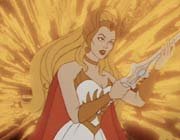
At the center of Etheria is She-Ra, He-Man's twin sister. Perhaps to her disappointment, she hasn't quite got the tan her brother’s managed, but as compensation, she does have lots of exciting girly powers. Alongside the Princess of Power is a group of plucky freedom fighters who aim to overthrow the tyrannical Horde, a group of alien invaders who have control of Etheria. Let the battle begin!

At a basic level, She-Ra Princess of Power differs little from its sibling series. They share the same animation style, voice artists and audio sound banks; on a story level, both offer moral tales that pit honest, heroic characters against incompetent, evil monsters; and both titles offer a simple message that their viewers can contextualize to real-life situations. However, on a closer look, there is a fair bit separating the two.

First, the actual overall scenario for She-Ra Princess of Power is a little less of a fairy tale than He-Man and the Masters of the Universe. While He-Man lives in a kind and honest kingdom ruled by a kind and honest King and Queen who are occasionally threatened by some silly fool, She-Ra lives in a world of oppression where freedom is the honest man's ultimate prize. In She-Ra, there is no even playing ground between good and evil: evil won before the series began, and it's a fight to get a foothold against the towering dominance of the Horde.

Naturally, She-Ra Princess of Power avoids letting the subject of forced oppression create too much of a dampener on the cartoon fun, but it's an issue that is rarely ignored. The show takes the question of freedom and the rights of the individual very seriously, occasionally placing mature issues at the center of its episodes. "Burning Books" is one episode on this box-set that, as its title suggests, has a close parallel in recent history. "Lost for Words" is a rather literal metaphor for the voice of resistance. And "The Price of Freedom" asks how far the value of freedom truly extends.

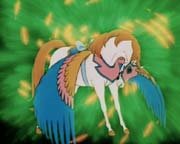
She-Ra's other major distinction from He-Man comes in its target audience. This is undeniably a girl-oriented production, as the creators themselves attest. In fact, the show has exactly what a girl would want: a talking horse. A talking, flying horse. A talking, flying unicorn horse. A talking, flying unicorn horse with multicolored wings. As the example suggests, it's a no-holds-barred pitch at the female demographic. Adding more to the G-Factor, we have a heroine who can communicate with animals as well as heal them. Throw in a cute owl, a dotty witch and the most effeminate male sidekick cartoons have yet to see, and you have the perfect girl action cartoon. On the commentary track, staff writer J. Michael Straczynski (a familiar name to Babylon 5, Fantastic Four and Spider-Man fans) mentions that Filmation brought in consultants to help design the show, and that one of their key concerns was that the heroine not hit anyone. Sure enough, you'll rarely spot She-Ra actually attacking anyone on screen.

Wisely, though, Filmation didn't ignore their already present male fanbase, and so they incorporated the already planned He-Man toy-line "The Horde" into She-Ra. This helped balance the show's character and give it a little more male orientation. Yes, Hordak and his cronies are an excellent counterpoint to the female-focused world of She-Ra. If She-Ra and the great rebellion are the dream of girls, the dirty mess of gadgets, monsters and transforming robots can only be the boy's sandbox. This again marks an interesting contrast between the sibling shows. Where He-Man and the Masters of the Universe blended magic and technology, She-Ra Princess of Power pitted the two against each other.

The stories on this first volume of season one—a staggering 32 episodes—make for a great watch. I was most impressed by the production efforts to give Etheria its own identity. That effort is obvious visually (and if that doesn’t convince you, the 97-page PDF series bible included on the disk set should be a further clue). In She-Ra there is real internal consistency. We have a world of different kingdoms with set characters in each. As the series unfolds we get to see a little more background to some of these places and the people that inhabit them. All this supports the basic principle of the show: the fight for freedom. By giving Etheria set places, it creates a chessboard for its pieces, and the battle becomes more real. That's not to say that there is any particular arc to these established locations and characters, but this focus on consistency really helps give the theme of occupation credibility, even when the theme isn't explored to any great depth.

The stories themselves are more character-oriented than in He-Man. You'll notice a greater mix of superfluous interaction and comic interplay. I found these plot-free inserts a refreshing change of pace, though occasionally they made the stories feel a little uneven.

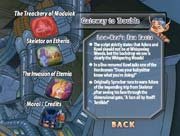
Episodes to watch out for? Don't skip "The Price of Freedom,” which is one of many He-Man crossovers on the box-set and certainly the most adult and challenging story of them all. If you are looking for comedy, "Gateway to Trouble" has some wonderful scenes between its guest star, Skeletor, and the evil Hordak. For gentle moral action, watch "The Stone in the Sword" or "The Peril of Whispering Woods." Of course, one cannot forget to mention the excellent five episodes that launch the series (and made up the He-Man and She-Ra movie, "Secret of the Sword"). You won't find many animated series introductions that establish a show as effectively as that story.

So what about the DVD box set itself? It's a great presentation that folds out with a richly colored panel of character images, and the disk prints themselves are beautifully rendered to match the panels that support them. The interactive DVD menus are well constructed, with some effective music loops and busy presentations. There are three different interactive menus on the six disks.

The episodes, as with Filmation's Flash Gordon recent full set release, have episode synopsis for each interactive episode selection. Furthermore, the chapter selection has a great little smattering of episode facts.

The extra disk of features is up to Filmation's usual standard. While the documentary is a fairly pedestrian affair so far as information goes, it does have an abundance of interviews from the production team and spans a decent duration. The character/location biographies are rich in both content and presentation, offering more detail than the previous Filmation DVDs I've seen.

For the CD-ROM owner, there is a fantastic wealth of PDF files, including not only the gigantic series bible but also a colouring book and the "Secret of the Sword" comic (a heavily edited adaptation of the aforementioned movie). There is also a collection of selected scripts to peruse. For the kids there is an interactive game and for the collector some artist trading cards. On top of all that you have the standard image gallery as well as a fantastic storyboard-to-episode comparison.

There are only two commentaries: "King Miro's Journey" with writer J Michael Straczynski and storyboard artist Micheal Swanigan, and "The Sea Hawk" with writer Larry Ditillio and editor Rick Gehr. The former is far more enjoyable than the latter, which is rather dry, but both are worth listening to.

Downsides? None to the box set itself, beyond the shortage of commentaries. The set is finely presented, easy to navigate, and chockfull of cool features. The stories themselves are also a solid collection. I can't even whine about the obligatory "Filmation fun" character hogging the limelight, as there is no such character in She-Ra! Yes, no Orko, Gremlin or MO. The nearest comparison is Kowl the big-eared owl, but his cynicism and smart-aleck quips at the fluff-for-brains archer, Bow, make for a true treat.

Aside from Hordak, the Horde aren't particularly amazing, but then, aside from Skeletor, He-Man's menagerie was fairly dull. Shadoweaver is just another version of Evil Lynn, though her relationship with Hordak proves surprisingly complex (see "A Loss for Words" and "The Eldritch Mist"). Imp is annoying but again has a curious relationship with Hordak. The rest are fairly forgettable, except for Mantenna. Never has a Filmation henchman had it so hard at the hand of his master.

From a production perspective, the glory of Filmation is there. There is great comfort to be found in the visual and aural predictability of stock animation and music. I would certainly buy any He-Man or She-Ra soundtrack if one were ever produced. The scores are amazingly effective and perfectly blend ambiance and action.

The biggest production hitch is with the voice artists. Their work is effective but lacks diversity. In fact, a great many are done by Filmation’s head honcho, Lou Schiemer (infamously Orko from He-Man). Unlike the pleasure found from the repetition of stock animation and music, a lack of diversity on the vocal track can be frustrating. Turn you eyes away from the screen and you'll be hard pressed to know whether that's Grizlor or a villager speaking. Sometimes the same electronic intonation is added to both, and this can be very confusing if you have the show on in the background. The stories may be fairly simple, but the lack of voices mean you have to pay attention!

Overall, this is another great Filmation box set, especially for nostalgic collectors. She-Ra is sorely under-rated, particularly beside its big brother, He-Man. That’s a shame, as She-Ra is a solid, well-written and ideology-focused universe. It might not give us any answers to our world's topical problems, but it’s a friendly reminder that freedom is something that should never be taken for granted. I think that's a message we can all appreciate, and She-Ra Princess of Power Season One Volume One is certainly an enjoyable way to experience it.